


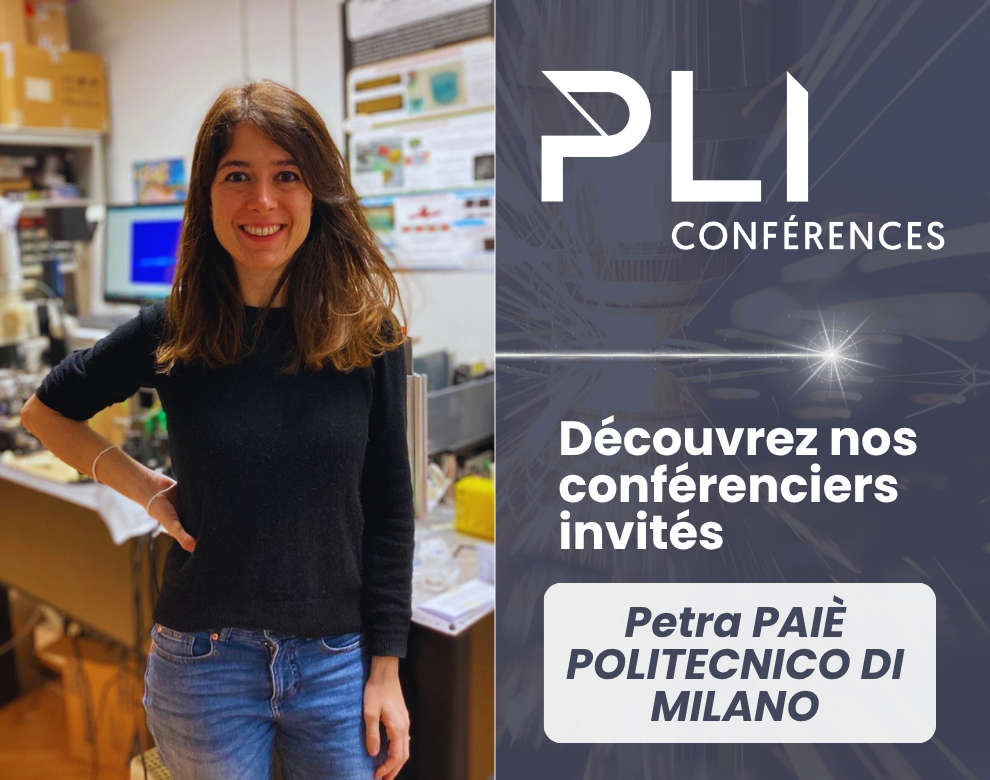
As the PLI Conferences, organized by the Club Laser et Procédés, approach on July 1–2 in Limoges, we are giving the floor to several speakers who will contribute to making this event a key gathering for the laser community.
Among them is Petra Paiè, Associate Professor at the Department of Physics of the Politecnico di Milano in Italy. A specialist in femtosecond laser microfabrication, she focuses on developing integrated optofluidic devices that combine optical components and microfluidic channels. Her work spans fundamental research, advanced imaging, and the translation of laser technologies toward application-oriented solutions.
In this interview, she shares her perspective on the evolving laser landscape, the trends shaping next-generation laser processes, and the importance of collaboration across research and industry to bring advanced technologies into practical use.
Could you briefly introduce yourself and tell us about the key milestones in your professional journey?
I am Petra Paiè, Associate Professor at the Department of Physics of the Politecnico di Milano. I hold a degree in Engineering Physics and a PhD in Physics from the same institution. After my doctoral studies, I worked at the Italian National Research Council (CNR) and was later awarded a JSPS fellowship at the University of Tokyo. I then returned to Politecnico di Milano, where I currently carry out my research activities.
My work focuses on the use of femtosecond lasers for microfabrication in glass, enabling the development of optofluidic devices that integrate optical components and microfluidic channels. Over time, I have combined this expertise with imaging and microscopy, aiming to develop compact devices for advanced imaging applications.
What excites you most today within the laser community?
What excites me most is the breadth and dynamism of the laser community. It spans from fundamental research to industrial applications, and it continuously evolves to meet both scientific challenges and market needs.
Every time I attend conferences or community events, I am inspired by the diversity of ideas and innovations. It is a field that constantly reinvents itself: grounded in solid principles and well-established methods, while always looking ahead to future developments. Being part of such an active and forward-looking community is truly motivating.
What major trends or breakthroughs do you believe will shape the future of laser processes in the coming years?
It is difficult to identify a single dominant trend, as the field is broad and rapidly evolving. From my perspective, one important direction is the increasing integration and miniaturization of photonic components enabled by laser processing.
In particular, chip-scale integration and the fabrication of complex, multifunctional devices have the potential to create a strong and lasting impact in monitoring, sensing, communications, and beyond. Many of the most impactful applications are likely still to be developed, but miniaturization will undoubtedly open the door to new possibilities.
Why did you choose to speak at the PLI Conférences, and what would you like to share with the participants?
I chose to speak at PLI Conférences because of its strong focus on bridging research and industrial applications of laser technologies. I find it particularly stimulating to engage with a community united by a shared focus on lasers, and I am sure there will be much to learn.
In my talk, I will present our work on femtosecond laser microfabrication and how we are developing integrated optofluidic devices for advanced imaging. A key aspect I would like to highlight is our effort to bring these technologies beyond specialized research laboratories toward more accessible, application-oriented solutions. While the path is still long, this transition represents an important direction for our work.
In your view, what role does the Club Laser et Procédés play in advancing and promoting laser technologies?
I believe that organizations like the Club Laser et Procédés play a fundamental role in connecting people, ideas, and disciplines. Exchange, collaboration, and cross-fertilization among different areas of the laser community are essential drivers of innovation.
Creating a space where researchers and industry professionals can interact helps accelerate progress and fosters new perspectives. I am really looking forward to participating and contributing to this community by sharing my experience.
Through her experience at the Politecnico di Milano, Petra Paiè exemplifies how advanced laser research can be translated into innovative applications with real-world impact. Her perspective highlights the essential role of collaboration, creativity, and interdisciplinary exchange in shaping the future of laser technologies.
The PLI Conferences will provide the perfect opportunity to continue these discussions and share inspiring experiences with the entire laser community. Join us on July 1–2 in Limoges to hear Petra Paiè’s presentation and explore together the next frontiers of laser technologies.
Don’t miss the flagship event of the sector!
>> Register now for the 2026 PLI Conferences