


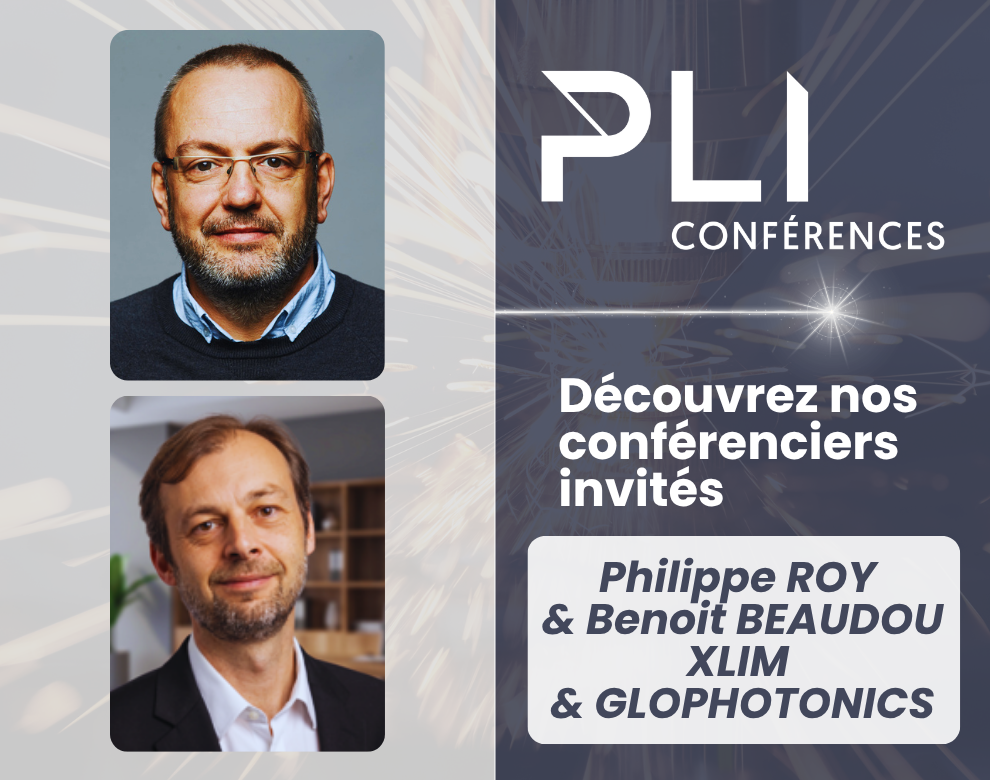
As the PLI Conferences, organized by the Club Laser et Procédés on July 1st and 2nd in Limoges, approach, we are giving the floor to our guest speakers who will bring this key event for the laser community to life.
Among them are Philippe Roy, CNRS Research Director at XLIM, and Benoit Beaudou, Senior Application Engineer at GLOphotonics. Both are recognized figures within the French photonics ecosystem and bring complementary perspectives on laser innovation, combining cutting-edge academic research with industrial development. With extensive expertise in specialty optical fibers, high-power laser sources, and ultrafast laser technologies, they have spent many years contributing to the advancement of laser solutions designed to meet tomorrow’s industrial challenges.
In this joint interview, they share their insights into the technological developments reshaping the laser industry, the challenges associated with scaling power and process flexibility, and the essential role of collaboration between research institutions, industry, and end users in accelerating innovation.
Could you briefly introduce yourselves and tell us about the key stages of your professional careers?
Philippe Roy
I joined CNRS in 1998 to develop research activities around air-silica microstructured fibers. I am currently a Research Director within the “Fiber Photonics and Coherent Sources” group at XLIM in Limoges.
My work broadly focuses on specialty optical fibers, with a primary emphasis on high-power fiber laser sources. In continuous or quasi-continuous operation, we are the only laboratory in France to have developed single-mode laser sources delivering more than 3 kW around 1 µm.
This work is carried out within XLase, a joint laboratory with CILAS, which hosts a full-time CILAS employee. For more than ten years, we have also been developing rigid fibers with extremely large mode areas for generating short pulses, mainly intended for micro-machining applications in electronics.
Together with BLOOM Lasers, we have established a second joint laboratory since 2025, again with a full-time employee seconded to our lab. Still focused on micro-machining, but for ophthalmology applications, we have also been supporting Hélix Surgical in scaling up its laser source.
The recent progress we have achieved is closely linked to technological developments, particularly our work on powder-based material synthesis, which enables excellent levels of control, even for complex refractive index profiles.
Benoit Beaudou
I am currently a Senior Application Engineer at GLOphotonics.
Regarding the key stages of my career, I would say that it is built around three main pillars.
First, my academic background: I earned my PhD at the XLIM Research Institute. My doctoral research focused on hollow-core photonic crystal fibers (HCPCFs) for mid-infrared generation applications, with a particular emphasis on their use in optoelectronic countermeasure systems.
Second, my industrial expertise: Over the years, I have accumulated nearly 10 years of experience in industry, specifically in the fields of hollow-core fiber technologies and ultrafast lasers. During this period, through collaborations with numerous international industrial partners, I gained exposure to a wide range of application sectors for femtosecond technologies.
Finally, my current managerial role: Today, I leverage this dual expertise at GLOphotonics by leading the “Beam Delivery” technology and business unit. Our mission is to develop beam delivery modules and customized solutions for ultrashort-pulse lasers. We also support our customers in integrating these systems into highly practical applications such as micromachining, surface structuring, and bioimaging.
What excites you the most today within the laser community?
Philippe Roy
At the beginning of my career, the average power of fiber lasers was expressed in watts, whereas kilowatt-class lasers are now common. Technological progress has consistently supported this increase in power, but fiber structures have often been the main drivers of innovation.
I believe there is still significant room for progress through the integration of advanced materials, both to further increase power and to enhance wavelength agility in future laser sources.
Benoit Beaudou
What excites me most today within the laser community is witnessing the increasing quality and maturity of our technologies. Just a few years ago, many advanced laser systems were essentially sensitive laboratory prototypes that required frequent adjustments. Today, we have succeeded in transforming these complex concepts into reliable and robust industrial equipment capable of operating continuously on production lines. Being part of this transition toward sustainable industrial standards is highly motivating.
This increase in reliability has naturally enabled another particularly exciting development: the growing diversity of application sectors. As laser processes have become more robust, they have been adopted across a wide range of industries. Today, they are used in medical applications such as surgery and bioimaging, as well as in defense, electronics manufacturing, and consumer goods production. Knowing that the photonic technologies we work on address such diverse and tangible industrial needs is extremely rewarding on a daily basis.
In your opinion, what major trends or breakthroughs will shape the future of laser processes in the coming years?
Philippe Roy
Laser sources emitting around 1 µm still have a bright future, but many projects are exploring the potential of other wavelengths. Rare-earth-based sources, possibly frequency-doubled or tripled, already represent a valuable pool of solutions.
However, given the diversity of industrial materials and the growing demand for more sustainable processes, I believe that improving efficiency will rely on greater wavelength agility in laser sources, without compromising power.
Benoit Beaudou
In my view, the future of laser processing will be shaped by several complementary trends aimed at making these technologies both more productive and more adaptable.
The first major challenge concerns the scaling up of industrial processes. The drive to increase productivity without compromising precision sometimes encounters the limitations of current hardware. Although we continue to see a steady increase in the average power of laser sources, peripheral components must also keep pace in order to utilize this energy efficiently. This evolution will necessarily involve significantly higher scanner speeds, as well as the broader adoption of process parallelization. By splitting a high-power laser beam into multiple secondary beams, it will become possible to process several areas or components simultaneously, dramatically increasing industrial throughput. We can also expect the exploration of new pulse regimes for specific applications, such as GHz burst modes.
Alongside these productivity gains, we are witnessing a significant expansion in the range of industrial environments capable of accommodating laser technologies. Historically, ultrafast lasers required highly controlled operating conditions. Today, thanks to substantial improvements in laser source robustness, they can be integrated directly into demanding production lines and harsher industrial environments. In this context, advancements in beam delivery systems can help overcome several technological barriers. This is precisely the focus of our work with hollow-core fibers: enabling the laser beam to be delivered from the source to the workpiece with complete flexibility and without any degradation in beam quality. Such developments greatly facilitate integration into robotic arms and confined workspaces.
Finally, to meet the demands of constantly evolving industries, the hyper-flexibility of micromachining platforms will become a decisive factor. Industrial users are increasingly seeking solutions that are less rigid and more versatile. Future platforms will therefore need to be highly agile, capable of switching seamlessly from one process to another—for example, from cutting to surface structuring—or adapting instantly to new materials. This hardware flexibility will undoubtedly be closely linked to software flexibility. We will see the emergence of systems capable of dynamically adjusting beam shaping, pulse duration, and other process parameters in real time, ensuring optimal performance for each specific application.
Why did you choose to speak at the PLI Conferences, and what would you like to share with participants?
Philippe Roy
Between an academic laboratory and an industrial company specialized in laser machining, several intermediaries are often required (technology transfer centers, laser manufacturers) to support the maturation of an innovation. However, direct exchanges about needs and capabilities help anticipate challenges and better prepare each party’s roadmap.
Benoit Beaudou
Our objective is to provide an overview of the beam delivery solutions we are developing at GLOphotonics.
In the spirit of transparency, we will also discuss the current limitations of our systems. The idea is to present the technical challenges we are facing and then share the various approaches our team is exploring to overcome these barriers. It is an excellent opportunity to engage in meaningful discussions about these issues with the broader community.
In your view, what role does the Club Laser et Procédés play in developing and promoting laser technologies?
Philippe Roy
Unlike large international conferences that academic researchers are used to attending, the topics addressed within the Club Laser et Procédés are much more focused, and the audience is smaller and more specialized. The CLP is undoubtedly an excellent catalyst for fostering synergies around laser technology.
Benoit Beaudou
The Club Laser et Procédés (CLP) plays a catalyst role within our industry. It is important to remember that photonics, while being a highly strategic and innovative field, remains a relatively fragmented sector. In this context, the CLP serves as a hub for exchanges, facilitating the circulation of technological information and market trends while strengthening mutual awareness among the various stakeholders—laser manufacturers, component suppliers, system integrators, and end users.
Beyond fostering industrial networking, the CLP also acts as a bridge between industry and academia. The development and promotion of cutting-edge laser technologies have historically relied on discoveries made in research laboratories. By maintaining close attention to emerging academic work, the Club facilitates technology transfer and helps companies identify and anticipate disruptive innovations.
Through their perspectives, Philippe Roy and Benoit Beaudou highlight the key trends shaping the future of laser technologies. Their complementary backgrounds illustrate the value of close interaction between academic research and industrial development, as well as the importance of technology transfer in transforming scientific breakthroughs into practical applications. Together, they offer an inspiring vision of the challenges and opportunities that lie ahead for the photonics and laser-processing community.
The PLI Conferences will be an opportunity to continue these discussions and explore these innovations at the heart of their ecosystem.
Join us on July 1st and 2nd in Limoges to explore the future of laser technologies!
>> Register now.