


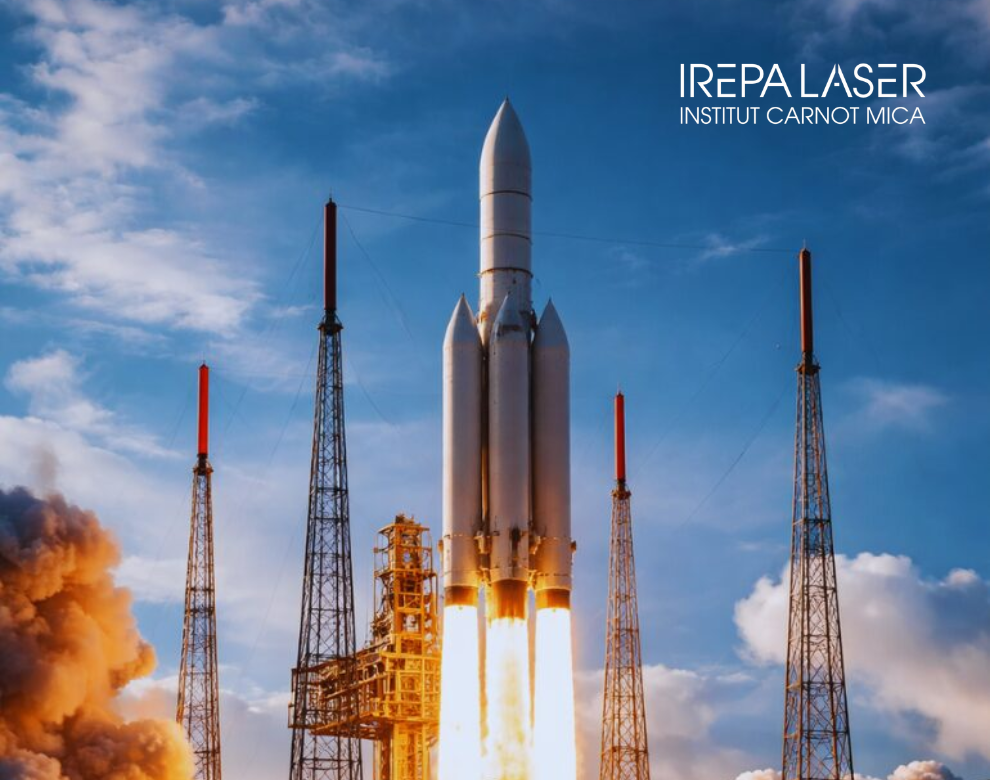
In the space sector, propulsion components are among the most critical elements of a launch vehicle. Exhaust lines, in particular, must meet high requirements in terms of mechanical strength, thermal resistance, geometric precision, and material quality.
Traditionally, these structures are manufactured by rolling metal sheets followed by welding assembly. While these processes are well established, they nonetheless present certain limitations: multiple steps, risks of localized defects, long production times, and increased complexity in ensuring repeatability.
In this context, IREPA LASER, as part of the European ENLIGHTEN-ED project, has explored an alternative based on laser powder DED (Direct Energy Deposition) additive manufacturing, aiming to provide a more integrated approach for producing these large-scale components.
Space exhaust lines: complex geometries with high criticality
Exhaust lines designed for space applications are large components (up to approximately 1 meter in height) featuring evolving and complex geometries.
Conventional approaches rely on:
- Rolling metal sheets,
- Welding assembly,
- Multiple finishing and inspection operations.
These involve a high number of steps, sensitive interfaces, and significant constraints in controlling deformations, particularly under thermal and mechanical loads.
The challenge is therefore to reduce reliance on assemblies while ensuring a high level of quality from the manufacturing stage.
An integrated approach through laser powder DED additive manufacturing
To address these challenges, an approach based on the laser powder DED process has been implemented, particularly suited for large metal parts.
The objective: produce more integrated components while minimizing the need for welding operations.
This approach relies on a complete development chain:
- Redesign of the part according to the process,
- Thermomechanical simulation,
- Definition of deposition strategies,
- Qualification on sub-geometries,
- Progressive prototyping,
- Dimensional and metallurgical inspections,
- Appropriate heat treatment (Inconel 625 alloy),
- Non-destructive testing.
Manufacturing is thus approached as a fully controlled process from the earliest stages.
Anticipating deformations and ensuring quality
One of the key aspects of the project lies in anticipating deformations induced by the thermal cycles of the process.
Simulation tools made it possible to:
- Predict thermomechanical behavior,
- Identify critical areas,
- Adapt manufacturing strategies,
- Develop geometric compensation models.
Validation was carried out at several levels (prototypes, 3D scanning, metallurgical analyses, non-destructive testing), ensuring a robust and progressive approach.
Concrete results on large-scale components
The work carried out within the ENLIGHTEN-ED project has demonstrated the feasibility of manufacturing complex exhaust lines using laser powder DED, with:
- A significant reduction in assembly operations,
- Improved functional integration,
- Controlled deformations through simulation,
- Validation on representative prototypes.
It also highlights the ability to produce large Inconel 625 components through a structured approach combining design, process, simulation, metallurgy, and inspection.
A contribution to industrial developments in the space sector
Beyond the technological demonstration, this work paves the way for more direct, flexible, and competitive manufacturing chains for critical components.
It highlights the potential of laser powder DED additive manufacturing to rethink the design and production of complex metal parts, particularly in highly demanding sectors such as space.
By contributing to the mastery of these processes, IREPA LASER supports the strengthening of industrial and technological capabilities for strategic components in the aerospace sector.
Learn more
Would you like to learn more about laser powder DED additive manufacturing or discuss your industrial projects?
The IREPA LASER teams are at your disposal:
>> Contact us via our form
>> Discover the ENLIGHTEN-ED project
The ENLIGHTEN-ED project has received funding from the European Union’s Horizon Europe program under grant agreement No. 101135156.