


As the PLI Conferences, organized by the Club Laser et Procédés on July 1–2 in Limoges, draw closer, we are giving the floor to several speakers who will help make this event a must-attend gathering for the laser community.
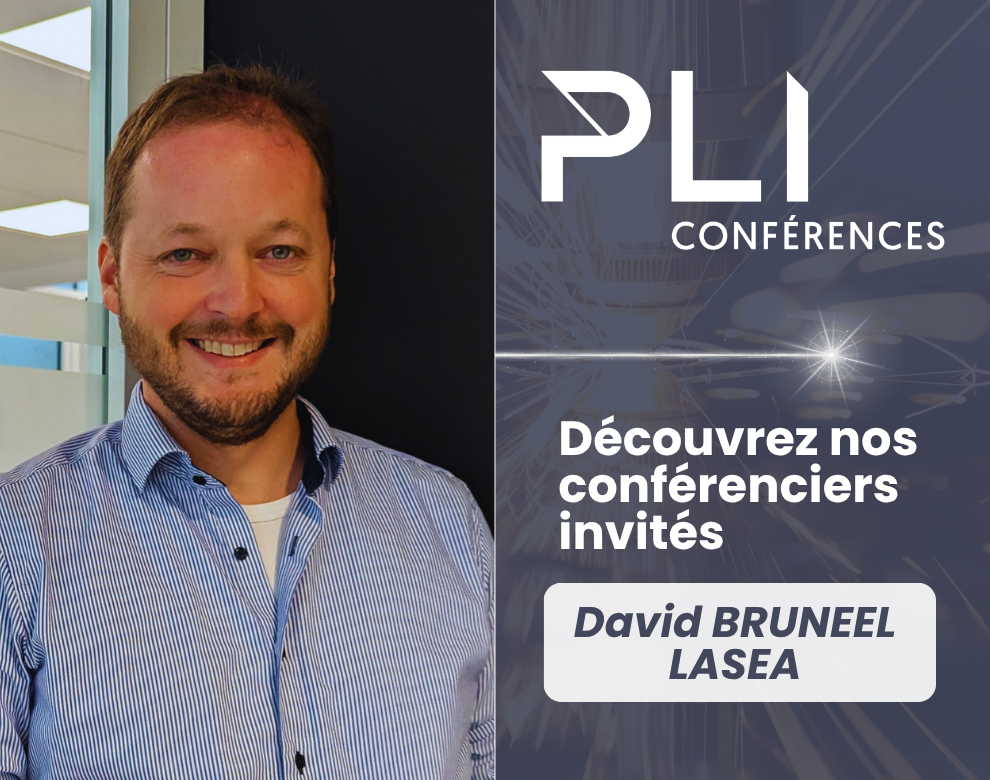
Among them is David Bruneel, Group Research Coordinator at LASEA. A recognized expert in laser micromachining, he has more than twenty years of experience in the development of innovative laser processes and high-performance industrial systems. His career has taken him from academic research to industrial development, with major involvement in leading European projects focused on ultrafast lasers, advanced manufacturing, and next-generation technologies.
In this interview, he shares his perspective on the evolution of laser processes, the technological challenges associated with high-power laser systems, the growing role of artificial intelligence in industry, and the importance of European collaboration in maintaining technological leadership in the field.
Could you briefly introduce yourself and tell us about the key milestones of your professional career?
I have been working in the field of laser micromachining since 2006, first at Fraunhofer IBMT and the Hubert Curien Laboratory, where I completed my PhD. I then spent several years in the United Kingdom, an experience that introduced me to the industrial world and a pragmatic mindset that I still embrace today through one of my favorite sayings: “the simpler the better.”
I joined LASEA in 2015 and currently serve as Group Research Coordinator. Throughout my career, I have gained more than twenty years of experience in the research and development of innovative laser processes for a wide range of applications, including cutting, drilling, milling, marking, trepanning, and surface texturing.
Over the years, I have worked on the development of systems integrating different laser technologies—including fiber, nanosecond, picosecond, and femtosecond lasers—as well as on the optimization of laser micromachining processes. Today, I coordinate the alignment of European and regional R&D projects with the strategic market needs addressed by LASEA.
This work has contributed to several major technological breakthroughs, including the demonstration of kilowatt-class femtosecond lasers and their integration into industrial systems. Among the most significant achievements is the world record in femtosecond laser ablation reached in 2019, with a material removal rate of 3.5 mm³/s. Our research also covers beam shaping, GHz burst-mode cold ablation, laser–matter interaction simulation, and high-speed surface texturing.
What excites you most today about the laser community?
The laser community is experiencing remarkable growth and stands out for its highly collaborative spirit, particularly in research and development. Exchanges are frequent, open, and largely international, especially across Europe.
While competition certainly exists, it is accompanied by a strong culture of constructive collaboration. As new competitors emerge rapidly around the world, particularly in Asia, Europe continues to hold a leading position, especially in the field of femtosecond lasers, where many European suppliers are recognized globally. Being part of this ecosystem is a source of great pride.
Another exciting aspect is the pace at which the technology continues to evolve. The power of femtosecond lasers has increased dramatically over the years, from just a few watts in the early 2000s to several hundred watts and now into the kilowatt range. Through collaborative R&D projects, we have contributed to the development of some of the first machines capable of operating at these extreme power levels and have acquired the expertise needed to integrate them into industrial environments.
The challenges ahead are both numerous and stimulating. The real difficulty is no longer finding challenges but deciding which ones to focus on.
In your opinion, what major trends or breakthroughs will shape the future of laser processing in the coming years?
One of the most significant trends is undoubtedly the integration of artificial intelligence into laser processing. At LASEA, we are currently developing models capable of automatically predicting the optimal process parameters required to meet a specific industrial need.
This evolution could fundamentally transform the way laser machines are used. Until now, operating these systems often required advanced expertise or many years of experience. Our goal is to make laser technology far more accessible and user-friendly, much like any other industrial production equipment.
Another major trend is the effective utilization of high-power laser systems. At a time when environmental challenges are becoming increasingly important, laser technology offers significant advantages. It operates solely on electricity and involves no wear of the “light tool,” making it a more sustainable alternative to many conventional manufacturing processes.
The continuous increase in laser power is opening the door to new industrial applications. To fully exploit this potential, every component of the technological chain must continue to evolve—from laser sources and optics to beam delivery systems and machine architectures. This is currently one of the strongest drivers of innovation in our industry.
Why did you choose to speak at the PLI Conferences, and what would you like to share with attendees?
The PLI Conferences bring together key players in industrial innovation, photonics, and advanced technologies. This ecosystem is perfectly aligned with the topics we work on at LASEA.
The event provides an excellent opportunity to discuss current industrial challenges, including miniaturization, precision, performance, and sustainability. I also look forward to sharing our latest advances in areas such as artificial intelligence applied to laser processes, semiconductor technologies, and emerging industrial challenges.
These meetings are also essential for identifying new collaboration opportunities and building joint projects that can accelerate the transfer of innovation from research to industry.
In your opinion, what role does Club Laser et Procédés play in the development and promotion of laser technologies?
Club Laser et Procédés plays a key role in structuring and advancing the laser industry. By bringing together industrial companies, researchers, and institutions, it fosters knowledge sharing, expertise exchange, and the creation of high-value collaborations.
Through events such as the PLI Conferences, as well as its technology watch and networking activities, the Club actively contributes to accelerating innovation and strengthening both French and European competitiveness in laser technologies.
Its actions also facilitate the industrial adoption of laser processes by bringing together user needs and the capabilities offered by the latest research and technological developments.
Thanks to his experience at the intersection of research and industry, David Bruneel provides unique insight into the developments shaping today’s laser sector. His career highlights the importance of collaborative innovation, technology transfer, and anticipating industrial needs to transform scientific advances into practical solutions.
The PLI Conferences will provide the perfect opportunity to explore these topics further and engage with the professionals who are shaping the future of laser technologies. Join us on July 1–2 in Limoges to attend David Bruneel’s presentation and discover the latest innovations transforming the industrial landscape.
Don’t miss the flagship event of the laser industry!
>> Register now for PLI Conferences 2026