


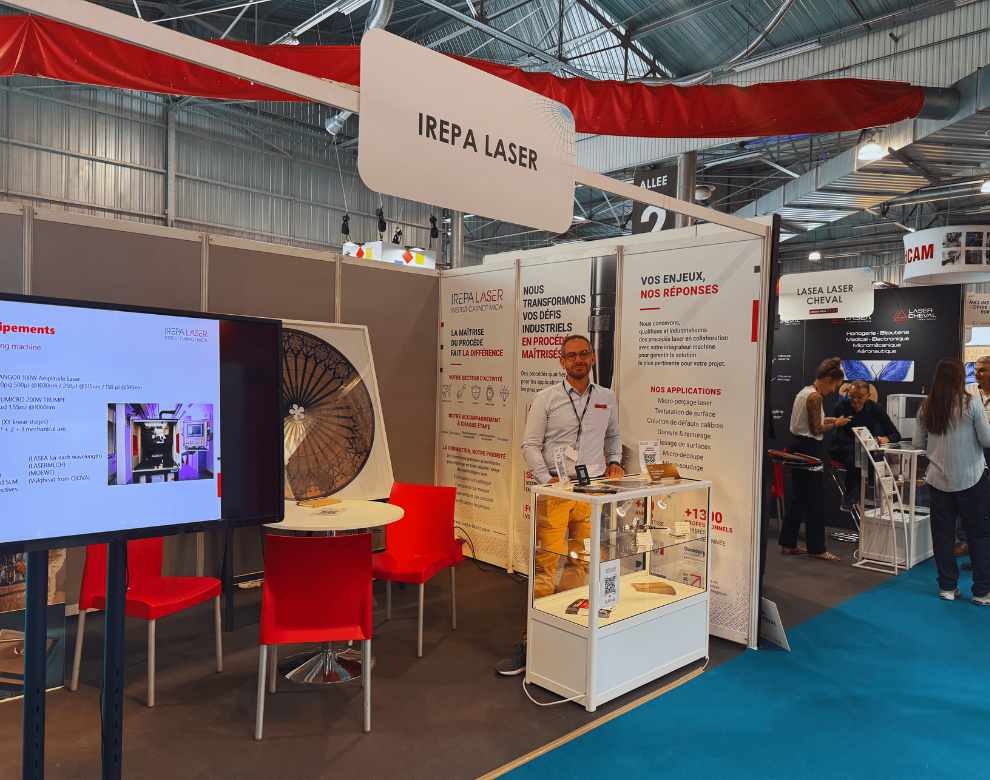
From 29 September to 2 October 2026, IREPA LASER attended Micronora as part of the Club Laser et Procédés collective exhibition area.
Over the four days, the trade show provided an opportunity to discuss very practical challenges with industrial companies: new materials, micro-drilling, complex geometries, surface functionalization, the need for greater precision, and reduced processing times.
Despite the diversity of these needs, one observation stands out: when it comes to laser machining, there is rarely a single, immediate solution.
One industrial challenge, several paths to explore
When addressing a new application, choosing a laser technology or a piece of equipment is only part of the solution.
Performance depends on many parameters: beam characteristics, the material and its surface condition, part geometry, as well as the toolpath, overlap, speed and process sequencing.
The same challenge can therefore be approached using different technologies and strategies.
This is particularly true when working with materials that are still poorly characterized, complex geometries or new surface functionalities. In such situations, experimentation makes it possible to compare several approaches before identifying those worth investigating further.
From idea to testing: a structured approach
This is the approach that IREPA LASER chose to highlight at Micronora.
The process begins with understanding the application: what function is required? On what material? With what geometry? What levels of precision, quality or production rate need to be achieved?
Based on these elements, different technological approaches can be identified and then compared experimentally.
The approach includes:
- Clearly defining the technical challenge and the required function;
- Analyzing the material and geometry;
- Identifying several technological approaches;
- Designing comparative tests;
- Observing and characterizing the results;
- Selecting which approaches to discontinue, retain or investigate further.
The objective is therefore not simply to achieve a result, but to understand why it is achieved and under which conditions it can be reproduced.
From micro-drilling to surface functionalization
This approach opens up a particularly broad range of applications.
Laser micromachining can be investigated for producing micro-holes or precise geometries in technical materials, performing localized material removal, producing fine cuts, or creating calibrated defects for the development and qualification of inspection systems.
Surface functionalization is another important area of application. By creating specific micro- or nanostructures, it is possible to explore how texturing influences certain surface properties, such as adhesion, friction or wettability.
In each case, the principle remains the same: start with the required function to determine which technologies and strategies should be tested.
Feasibility is only the first step
Achieving a satisfactory result during a test is not enough to define an industrial process.
Once feasibility has been demonstrated, other questions arise: is the result repeatable? What is the acceptable process window? Can cycle time be reduced while maintaining the required quality? What inspection criteria should be implemented?
The work can then continue towards process optimization, validation of repeatability, qualification and, when the application allows, preparation for transfer to industrial equipment.
This progression helps to gradually reduce uncertainties and transform a technological approach into a better understood and controlled process.
Micronora: a forum for discussing tomorrow’s applications
The discussions held during Micronora 2026 confirmed the wide variety of challenges currently faced by industrial companies.
Some applications still require further exploration of the potential of laser technology. Others already rely on an established process and are now seeking improvements in precision, quality, repeatability or production rate.
Above all, this diversity highlights the fact that innovation in laser processing does not rely solely on equipment performance. It also depends on the ability to experiment, characterize, compare and understand the interactions between the laser, the material and the industrial application.
This is the approach that IREPA LASER was pleased to share throughout the four days of Micronora, alongside the members and partners of Club Laser et Procédés.
> Do you have a project? Contact us.