


During the 2026 edition of the PLI Conferences, held in Limoges in early July, the Club Laser et Procédés launched its very first Poster Session dedicated to PhD students. This new initiative was designed to showcase the work of young researchers while fostering exchanges between academic laboratories and industrial stakeholders in the field of laser processing.
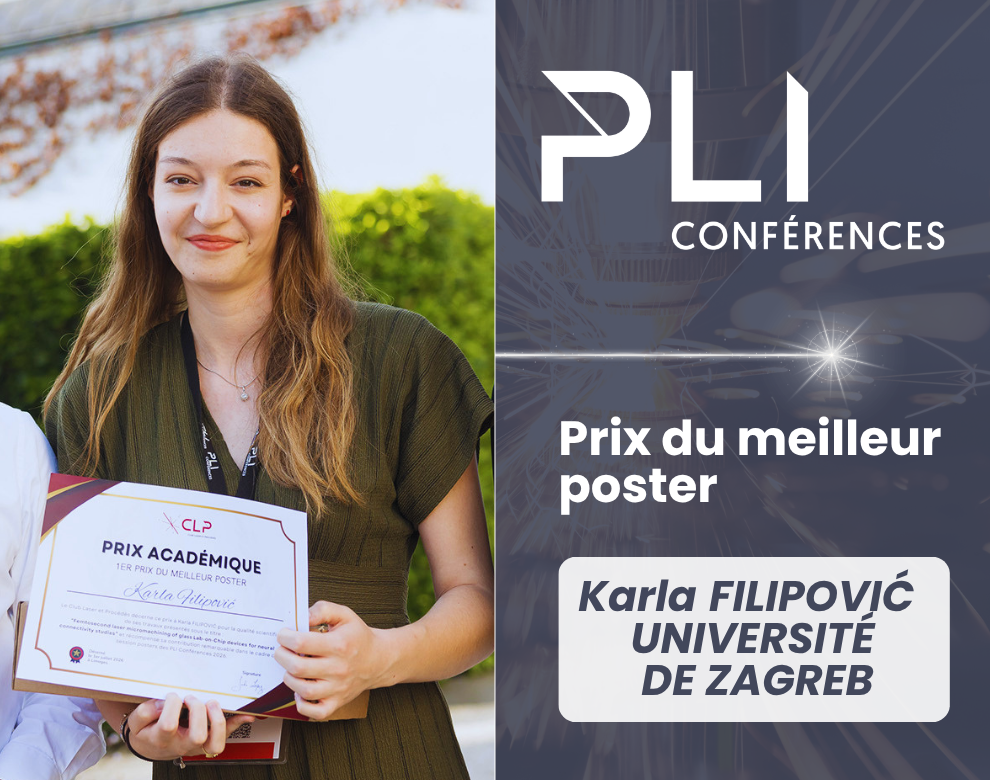
A highlight of this first edition was the Best Poster Award, created to recognize the scientific quality and industrial relevance of the posters presented. This year, the award was presented to Karla Filipović, a PhD student at the Faculty of Science, University of Zagreb.
She looks back on her research, her experience, and what this first Poster Session meant to her.
Could you briefly introduce yourself and tell us about the topic of your poster?
"My name is Karla Filipović. I work as a research and teaching assistant at the University of Zagreb Faculty of Science, Department of Physics and I am currently in the second year of my PhD. I work in Vedran Đerek's lab, which focuses on optical atomic spectroscopy and photonics. My poster, “Femtosecond laser micromachining of glass lab-on-chip devices for neural connectivity studies,” presented a microfluidic device we developed to grow and study neural organoids in vitro. Understanding how neurons connect and communicate requires a controlled environment where we can observe network formation over time, so we designed a glass lab-on-chip device fabricated using different femtosecond laser micromachining techniques, namely structuring, cutting, and welding. Eventually, we plan to use it as a platform for pharmacological and electrical stimulation studies, to better understand how external stimuli shape neuronal connections."
Why did you decide to take part in the Poster Session at the PLI Conferences?
"I actually spent some time on an Erasmus exchange with the SLAM group at CELIA in Bordeaux, where I worked on laser welding of thin fused silica slides. When the group decided to present at PLI Conferences, I joined in as well. It felt like a good fit for this work, since PLI Conferences brings together an interdisciplinary audience and is a great place to show what laser micromachining can create - from precise structuring to functional devices like ours."
What will you remember most about this first Poster Session?
"What I'll remember most is the two-minute pitch we had to give before the poster session itself. At first, condensing months of work into two minutes felt like a real challenge, but it turned out to be a great exercise, and I got a lot of positive feedback on it. Then during the poster session, the discussions themselves stood out too. People asked very specific questions about the fabrication process, seemed genuinely interested in the applications and even suggested some different approaches I hadn't considered."
What does winning the Best Poster Award mean to you?
"It means a lot, especially this early in my career. It's encouraging to know that the work is resonating with people outside my immediate field and I'm very happy to continue the work. I am looking forward to the next steps like running the neuronal culture experiments, optimizing the device geometry further and then (hopefully) finishing my PhD."
A promising first edition
With this first Poster Session, the PLI Conferences successfully achieved their objective of providing PhD students with a dedicated platform to present their research, exchange ideas with the scientific and industrial communities, and showcase their work.
The Club Laser et Procédés warmly congratulates Karla Filipović on receiving the Best Poster Award and thanks all the PhD students who contributed to the success of this inaugural Poster Session. This initiative is set to continue at future editions of the PLI Conferences, further strengthening the links between academic research and industry in the field of laser technologies.