


CHARMILLES, the laser solutions brand of Swiss group UNITED MACHINING SOLUTIONS, will be exhibiting at MICRONORA 2026.
CHARMILLES specializes in laser texturing and micromachining solutions.
Its offering is based on an ecosystem combining machine platforms with the LaserSUITE360 CAD/CAM environment, providing comprehensive control of the process.
Pushing the historical limits of laser machining
While laser machining has established itself thanks to its “non-contact” nature, it has long been constrained by well-known physical limitations: taper angles that are difficult to control, rounded edges, and uneven material removal.
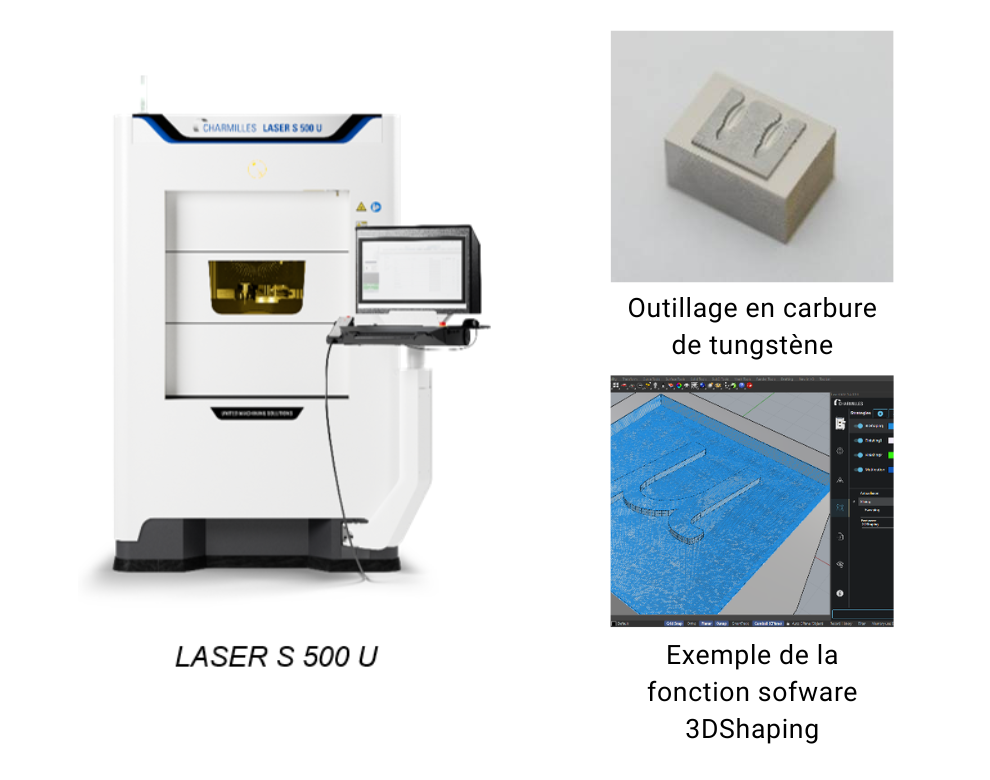
With 3DShaping, CHARMILLES overcomes these limitations through close integration between a high-performance machine platform and dedicated multi-axis CAD/CAM strategies.
The objective is to handle the most demanding “micro 3D” geometries.
Machine-software integration designed for precision and repeatability
Achieving straight walls and sharp edges requires multiple machining orientations, coordinated optical adjustments and mechanical movements, as well as precise alignment at every position.
The combination of the LASER S 500 U and 3DShaping meets these requirements.
Achievable performance and demonstrated results
The solution enables, among other benefits, precise control of angles (positive, zero or even negative taper, depending on the conditions), a uniform and controlled material removal (typical flatness of 2 to 5 µm), high repeatability, and sharp edges (≤ 5 µm depending on the application).
To summarize:
- Surface finish after laser micromachining: Ra ≤ 0.15 µm
- Geometric accuracy: ± 5 µm (form retention)
- Positioning accuracy: ± 3 µm
New industrial perspectives: digitalisation, competitiveness, resilience and sustainability
Beyond performance, the LASER S 500 U and 3DShaping solution introduces a fully digital workflow driven directly from the CAD/CAM environment, enabling faster implementation and efficient adaptation to new geometries.
All of this contributes to simplifying the manufacturing chain according to a lean approach.
The solution also contributes to European industrial resilience by facilitating the re-internalisation of production for complex, high-precision components, reducing dependence on distant subcontractors and sensitive supply chains.
Finally, the process stands out for its low resource consumption, requiring no consumables, no electrodes and no cutting tools, while offering the potential to reduce energy consumption compared with conventional processes such as milling or electrical discharge machining.